…

Mendocino County is Failing its Cannabis Industry
The Mendocino County government has created a bureaucratic nightmare for cannabis operators through high fees, unfair taxes, and complicated permitting. These obstacles should be removed in order to boost the local economy.

Higher Origins Published Apr 06, 2026 · 29 min read
Mendocino Counties Cannabis History
Mendocino County is located along the North Coast of California, bordered to the North by the redwood forests of Humboldt County, and to the South by the wine country of Sonoma County. Historically, Mendocino County, or Mendo as it’s frequently referred to by locals, had an economy driven largely by the logging industry. Over the years, the logging mills closed, and counter-culturally minded people from the Bay area started moving to the area in search of cheap land and a rural environment. This isolated environment with an economic vacuum and a unique combination of cultural values lead to an economic revolution.
The vast tracts of wilderness in the area, coupled with the Mediterranean coastal climate, were perfect for growing cannabis. Ex-loggers with encyclopedic knowledge of the mountains joined forces with local entrepreneurs, resourceful back-to-the-landers, and pot-loving hippies to begin building a unique cannabis economy. The US government’s drug war kept prices high, sometimes exceeding $5,000 a pound for those brave enough to risk growing, selling, and transporting the product. Despite frequent raids and the bombastic rhetoric of politicians, the illegal cannabis trade thrived.
The economic stimulus brought to the region via top-dollar pot prices created a regional small business success story that would give a politician wet dreams if it occurred in any other industry that paid their PACs. This cash influx allowed for the formation of a highly specialized regional industry, with deep knowledge, business connections, and, in comparison to the previous logging industry, reduced environmental impact. All of this happened organically, and over a time period of more or less three decades, Mendocino County and its compatriots Humboldt and Trinity to the North became known and praised worldwide as the Emerald triangle; an appellation on par with the wines of Champagne and Napa.
The love for cannabis that drove the high prices of the past, combined with a lull in the drug war, medicinal potential, a more liberalized view of cannabis in general, and a perennial government desire to extract tax revenue lead to legalization. It was slow at first, with medical-only programs and sporadic decriminalization. Then, some states legalized recreational markets, and the Federal Government established a policy of salutary neglect through the Cole Memo. Finally, in 2016, California voters approved a referendum legalizing recreational cannabis.
Early to Peak Legalization
In the years prior to Prop 16 legalization, the Mendocino County Sheriff ran a program where legal medical patients or their designated caregivers could purchase zip ties to mark legal medical plants. The zip tie program was widely regarded by medically oriented growers as successful, if a bit limited. It was simple and pretty open ended, and there was a lot of bending of the rules, but in general it marked a somewhat reasonable truce between law enforcement and those growers who were willing and interested to operate within a legal regulatory regime. When legalization opened up, many of the farmers already growing medically with zip ties were eager to pursue a legal license in good faith.
When legalization hit and the opportunity to become a licensed cannabis grower opened up, everyone in Mendocino County was excited and nervous. On one hand, the opportunity to be legitimized and free of the threat of violent police paramilitary enforcement was a huge relief. On the other, the opening up of the full market was sure to lower costs far below the thousands that everyone was used to. Nevertheless, thousands of potential licensees lined up to get licensed. A year later, the County had only issued 200 permits to 1,187 applicants. Everything was complicated, and nothing came easy. Every change or step forward seemingly required a fee, a specialist, a waiting period, and a bloat of obtuse and poorly explained paperwork. People started to get annoyed.
It Falls Apart
It turns out, that annoyance was just the beginning. The County’s pattern of ineffective management never changed. The mountain of red tape remained, despite a reorganization that transferred cannabis to the Planning and Building department. State level issues also contributed, with a looming deadline for temporarily permitted Provisional permits to be processed into bureaucratically complete Annual permits- a process that went straight through County offices. Years later, in 2023, the County had still somehow managed to only approve 1% of Annual permits, far below the state rate of 49%. To add insult to injury, 2.2 million dollars of State grant funds meant to ease the cost of licensing and permitting in Mendo were slow-walked, with many recipients still fighting for their funds to this day. These failures, coupled with rock-bottom pricing and a State-mandated distribution model that systematically exploits and marginalizes small rural operators, have resulted in a steady loss of legally licensed farms in Mendo, a trend which continues to this day.
How Much Has Mendo Lost?
As of the beginning of 2026, there was 3,592,000 square feet of licensed canopy in Mendo, a drop of ~ 46.5% since the county peak in 2021. Combine that 46.5% with the many cultivators who have had to cut back some or all their canopy area to remain in business, it is not an unreasonable estimate to say that half of the county’s legal cultivation has been lost in 5 years. Out of the 39 counties with data relevant to the same time period, Mendo ranks 29th. This is behind Trinity (22nd with -19.6%, incidentally the poorest county in the state) and Humboldt (27th, with 39.4%).
These losses in cultivation are matched by major reduction in commercial licensing like retailers and distributors, and manufacturing licenses like packaging facilities and concentrates labs. County commercial licensing is down ~28% from peak, and manufacturing is down ~33% from peak.
Mendocino ranks 4th statewide for most licenses lost, 461. Since 2021, the county lost more licenses than Los Angeles, San Luis Obispo, San Francisco, Kings, Riverside, Calaveras, Nevada, San Diego, Kern, Imperial, Sacramento, Inyo, Colusa, San Mateo, Mono, San Benito, Santa Clara, Marin, Solano, Stanislaus, Siskiyou, and Yuba counties, COMBINED. Trinity and Humboldt, Mendocino County’s compatriots in the Emerald Triangle, have proportionally lost less canopy than Mendo, and have also eliminated or seriously reduced their cannabis taxes.
Community Feedback
We surveyed all cannabis licensees in Mendocino county with this survey. Going through the responses, we can clearly see what growers have been subjected to. Let’s start with the general observations they have made about trying to grow in Mendo. Quotes are word-for-word direct from respondents.
Tax and fee burdens have starved the local economy
Respondents repeatedly connected their financial losses directly to lost spending in the local economy on employees, contractors, supplies, and infrastructure. Mendocino County is rural and growers rely on local businesses to help them operate and supply their farms. Money made here gets spent here. Less money in grower’s pockets translates directly to less local economic activity, spending, and jobs. One farmer said: "I spent $40k on True Up taxes I could've used to build a solar power system ... I could've hired a farm manager and paid them a $40k annual salary to help me run my farm."
State market prices and the Distribution model are stacked against small producers
Farmers are already on shaky footing even without the obstacles imposed by the County. State mandated distributors shut Mendo farms out of the margins available in retail sales, extracting the value of the County's high quality products and paying a fraction of what consumers pay in a dispensary. "The distribution sector being the bridge for transactions between cultivator and retailer limits even more the possibility of our craft products to enter the commercial market, since distribution focuses more on moving bulk than branded products." Furthermore, the lack of legal options to recover revenue from non-paying distributors poses massive financial risks. One farmer’s response was clear: "I've had to drastically cut back on the farm since being legally ripped off three times since 2017, when I started I was getting $1,200 a pound. We are now down to $250–400 hand trimmed. This is the most expensive hobby I've ever had the displeasure of continuing and yet here I still am 8 years later."
Mendocino's cannabis is world-class — and the county is squandering that brand
Farmers expressed deep frustration that the county has failed to capitalize on or protect the Emerald Triangle's legendary reputation. One grower who is hopeful that the changing regulatory landscape will bring salvation said: "Hang in there, once commerce opens we are back on top. No one in the world wants any other cannabis but one location's flower. It's the Emerald Triangle making California number one. We will be sold out for life. Then the County should recognize the abuse they put us through" Another noted the county had "promised to brand and market on our behalf" and failed to deliver.
Cannabis farming here is an act of land stewardship, not just commerce
Several respondents pushed back against the criminalization framing and emphasized the environmental and community ethic behind their work. “I would like people to know that Cannabis cultivation here in Mendocino and in the broader Emerald Triangle, is about much more than just farming. It involves caring for the land, protecting the environment, and managing natural hazards like fire risks. Growing cannabis responsibly requires education, dedication, and a deep respect for the mountains, the soil, and the surrounding ecosystem. For those of us who choose to farm here, it’s a commitment to stewardship, to improving the land, and to creating a better future for the community and the next generation.”
Specific Complaints
Survey respondents shared a wide variety of complaints with the County’s actions. Here’s the breakdown of what they had to say and the background of some of these complaints.
Excessive, duplicative, and disproportionate fees and taxes
The volume and layering of fees like county taxes, permit fees, water board charges, and code enforcement fines was the dominant complaint by a wide margin. "I was just hit with 3000$ in Permitting fees if I want to move a temporary structure (a cargo container I use to dry in) to a more convenient location. 700$ to “demo the old ones” and 800$ to issue new structure permits in a new location." Another summed it up: "Taxation without representation — and if they remove or lower any tax, they beat you up on another end with the insane building and planning fees."
Let’s take a closer look at those Cannabis Taxes:
According to Chapter 6 of the county code, Mendocino County has the authority to impose taxes on licensees operating in the unincorporated areas of the county (outside city limits). According to the Mendocino County tax office (confirmed 3/11/26), the current annual tax rates are as follows:
Gross Receipts Tax
2.5% for cultivators, 5% for dispensaries
Minimum Tax
$1,500 for cultivators with up to 2,500 square feet of active canopy
$2,500 for cultivators with up to 5,000 square feet of active canopy
$5,000 for over 5,000 square feet of active canopy
There is no minimum tax on dispensaries.
All other commercial and manufacturing licenses pay a flat tax of $2,500.
The county supervisors voted to impose a series of gradually decreasing tax reductions on all licenses except for retail. Currently that reduction is 35%, expiring at the end of 2026. The Board of Supervisors may increase the taxes either by 2.5% annually to a maximum of 10%, or based on CPI data.
A cultivator may choose to fallow (leave uncultivated) some or all of their licensed canopy area for a tax year. If they report this properly to the county, they will be subject to the minimum tax rate for only their cultivated canopy square footage.
Cannabis taxes are due every 3 months. Most cultivators pay their minimum tax. The County then reconciles their reported sales and if there is any additional payment due, a “true-up” tax is due for the difference. These true-up taxes are charged even if the sales they are levied on don’t generate collectible revenue from distributors, and the tax calculation every quarter creates a large bureaucratic burden for the County.
Fees Imposed By The County
In 2025, Mendocino County imposed a 71% fee increase on cannabis permitting activity, as well as other fee increases. These increases are due to the “Cost Recovery” payment structure that the County has adopted, which requires that county functions include fees or other financial means to pay for the time that County staff spend working on those functions. The County argues that these increases are necessary for budget balancing, while opponents argue that these fees impose even greater downward pressure on local economic development.
Chronic administrative incompetence and lost paperwork
Farmers described a pattern of disorganization at the county level that cost them enormous time and money. "the Cannabis Department lost our application, reports and other important paperwork requested for all the work done. This happened many times, forcing us to appeal when unfair mandates were issued. For example, when they wanted us under Kristin Nevadal’s supervision to present a full new application under phase 2 back in 2021/2022, because they lost all our files." Another recalled: "They lost all of our paperwork, making us have to resubmit everything as they jumped around a bunch of offices, very costly."
Repeatedly, complaints were leveled at a previous Director of the County’s cannabis program, Kristen Nevadal, who served from March 2021 to April 2023. Nevadal’s tenure was notable for delays, paperwork loss, and a reporting error that claimed that millions of dollars of State grant money for cannabis farmers had been distributed when it had not been. Respondents and our own Higher Origins users report that during their frequent visits to the County office to conduct cannabis business, the employees there often display a clear lack of understanding of the rules and regulations they are supposed to be processing paperwork for.
Canopy size limits are not competitive and economically crippling
The 10,000 sq ft cap was cited repeatedly as a structural disadvantage that makes profitability nearly impossible. "We are limited to 10,000 square feet of canopy... We are getting crushed by the volume other counties allow (i.e. Humboldt 20k), so we are forced to work twice as hard and still get half as much."
Mendocino County’s Cannabis Ordinance caps cultivation of mature plants at 10,000 square feet per parcel, caps the number of licenses per person, and caps nursery cultivation at 22,000 square feet per parcel. A parcel may not have more than 14,000 square feet of greenhouses. Likewise, limits on distance from property lines, zoning, and minimum parcel size for certain licensing further limits which parcels are available for cultivation. These limits shut out many legal potential growers who cannot afford to buy the correct land to match the licensing requirements, which incentivizes people to grow illegally. Finally, large, well-capitalized operators can bypass the license caps by simply leasing out the licensed premises of existing licensees. This allows rich investors to access an uncapped canopy of Mendocino County cannabis, while law abiding operators with less funding are shut out from reaching economies of scale.
Permitting requirements for basic farm structures are absurd
Farmers expressed outrage at being required to pull expensive permits for rudimentary or temporary agricultural structures. "I was required to pay $8,000 in code enforcement violation fees for hoop houses I didn't even know needed a permit... nothing more than PVC pipes holding trellis to keep plants from falling." One added: "Mendocino County has created many obstacles for cannabis cultivators by enforcing regulations based on an unrealistic framework. I’ve been required to permit structures including containers and shade setups that aren’t even permanently anchored to the ground. "
The county provides no meaningful services or protections in return
Farmers were emphatic that the fees and taxes they pay yield nothing back — no law enforcement protection, no market support, no advocacy. "A sheriff's department that does not protect us when we are robbed or harassed by thieves — therefore there is a massive lack of enforcement." Another put it bluntly: "Right now my partner and I are having to use our Social Security checks to help keep the farm going... I can't really think of any benefits we receive from this local government."
Proposed Solutions
Our survey respondents also identified some key solutions they would like to see implemented to help reduce the pressure on the cannabis industry in Mendo.
Eliminate or drastically reduce county taxes and fees
The single loudest consensus across respondents was that county-level taxes and fees must be slashed or abolished entirely, with regulation left to the state. As one farmer put it: "Drop all taxes and fees, let the state's legislature handle our regulations, not add more on top of the state!" In the view of cannabis operators, merely stopping new taxes would not be enough, and actual justice would involve wiping out outstanding tax debt and freezing fees for farmers who can't operate. "Tax forgiveness, wipe out all outstanding taxes with Mendocino County for licensed cannabis farms" and "if a farmer cannot cultivate for any reason, I would eliminate all fees for that year and allow the permit to be frozen without payment." The reduction/removal of taxes and fees would align clearly with policy changes in Trinity and Humboldt counties. While there are arguments that can be made in favor of the “Cost Recovery” fee structure to stabilize the county’s budget, such a fee structure removes the budgetary pressure to economize or view permitting work as an investment rather than a job security vehicle for bureaucracy. The minimum tax that operators must pay is not based on their actual economic performance, and is really just another licensing fee in disguise, designed to justify further bureaucratic overhead to calculate the true-up tax. Taxing operators before they make money is exploitation. Renewal fees should be waived for existing operations, and all cannabis-specific licensing fees should be cut by 50%. Additionally, licensing fees should be Frozen in years that saw a reduction in County licensing for that category of license.
Align permitting fees with those of conventional food farmers
Multiple respondents pointed to the claimed disparity between what cannabis licensees pay for structures versus what conventional agricultural operations pay for the same thing. One farmer laid it out plainly: "Structure fees for non-cannabis structures that are identical to cannabis structures are considerably less expensive." One possible pathway to achieving this would be to require every fee charged by Planning and Building on a licensed cannabis property to be capped in price at the same level as the most recent non-cannabis instance of that permit type in the county records. For example, if a cannabis farmer wanted to add an outbuilding, P&B would pull the most recent record for a non-cannabis outbuilding with the same permit type and similar size, and would use the fee cost of that outbuilding as the maximum for the cannabis farmer’s permit.
Expand canopy size allowances
Farmers widely called for larger canopy limits, arguing the current caps make operations economically nonviable, especially compared to neighboring counties. "They need to let us have a bigger canopy size , an acre plus" and "we need more canopy size because the margins are razor thin." One respondent noted the competitive disadvantage directly: Humboldt County allows 20k sq ft while Mendocino caps at 10k. Early in legalization, caps were discussed as a way to prevent huge farmers from moving in and shutting out small operators. Unfortunately, this has already happened due to megafarming in other parts of the state, aided by the mandated distribution model. At this point, capping grows only hurts the local economy. Would the County consider placing a cap on vineyard size? Of course not. The same logic should apply to cannabis. The County should remove caps and allow any level of State licensed square footage.
Develop cannabis tourism as an economic engine
Several farmers proposed leaning into Mendocino's unique assets to build a cannabis tourism economy. "One could travel here, staying at our local bud and breakfast, enjoying the counties local wine and weed... the list goes on, and the county finally makes honest tax money . That could lower taxes across the board." The comparison to Santa Barbara's wine and cannabis tourism model was raised as a blueprint the county has failed to follow. A county doesn’t always get to choose what makes it famous, but it can choose how to best manage that fame. For a county more than happy to put wine grapes as the first image on their website, boosting a second widely popular agricultural crop to drive tourism should not be a challenge since they already have a blueprint that works. We suggest
Additional Solutions from Higher Origins
We've spent some time formulating a few additional solutions for some of the problems that operators in this county face. Here's a list:
Eliminate inspection fees for licensed premises in cases where no violation based on State regulations is found, or in cases where the violation has no observable negative environmental impact and can be abated within 72 hours with no County input other than a simple visual inspection.
Create a public fund for grant money to support local operators in expansion of their onsite distribution and manufacturing capabilities, which would empower local farms to self-brand and approach the lucrative retail market, rather than relying on the rock bottom pricing of the wholesale market. Waive fees on the creation of manufacturing/packaging licenses and promote shared-use manufacturing.
Create an amnesty program in which licenses lost in the last 4 years can be re-issued their County permits at no additional charge as long as they can satisfy State licensing.
Eliminate fees on all hoop/greenhouses without concrete slabs, poured footings, or the need of earth moving to install.
For cultivation, remove the per-license square footage cap, and replace it with a publicly debated and voted on cap on total square footage per property. This would allow a licensee to cultivate as many State licenses as they want under one County license associated with that property, without having to pay for multiple County licenses on one property. For example, if the County license cap was voted as one acre per property, then the licensee could have one Medium State license, or many smaller licenses on that property, and only pay one County license fee.
Eliminate fees on installation/moving of shipping containers on cannabis properties, or for all agriculture properties for that matter.
Consider establishing a coalition with the governments of neighboring counties to compare notes on what works and what doesn’t in terms of policy. Include community cannabis licensees in the process wherever possible.
Eliminate “Demolition fees” on shipping containers and hoop/greenhouses.
Strongly consider eliminating the cannabis department entirely and returning full control of the program to the department of agriculture. In a public process, reconcile all cannabis department rules with existing department of agriculture rules, effectively rendering cannabis farms indistinguishable from food/vineyard agriculture in the eyes of the County.
Publicly vote on and publish a set fee schedule for cannabis businesses, explicitly describing the context in which they can be charged, the amounts thereof, and the conditions in which they can be raised.
Publicly vote on and publish an expected time frame schedule for the processing of Planning and Building permits for cannabis license activities, and establish a waiver of all fees levied upon the licensee in the case that the process exceeds that expected time frame.
For all Planning and Building fees levied on cannabis licensees, cite the most recent non-cannabis approval for the identical permit/approval in the county records. The cannabis fees cannot exceed the cost-per-square-foot of the cited similar non-cannabis fees.
The Current Political Landscape
The struggle of farmers in Mendo is not a closed case, and the political situation is evolving. As the cannabis economy continues to strangle, County politics continue to progress. Elections are coming up, and the cannabis tax reductions will be expiring at the end of the year. California recently paused a massive statewide tax increase, citing the poor economic conditions for cannabis operators. As inflation ticks up due to political and trade upheaval worldwide, Mendo residents and cannabis consumers statewide are tightening their belts. Now is as good a time as any for Mendocino County cannabis operators and constituents to flex their political will through media, outreach, official inquiry, and in the voting booth.
A Candidate in Their Own Words- And a Notable Silence From Everyone Else
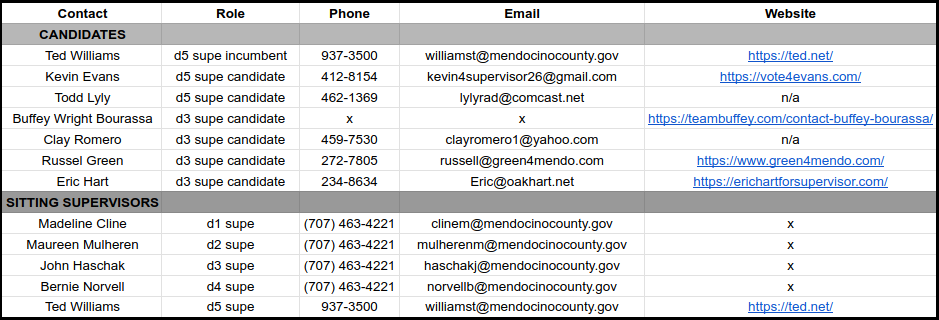
The County Board of Supervisors has two seats which will be up for election in June. We reached out to all registered candidates and all sitting supervisors with this questionnaire. We received two responses- one was an email from Supervisor Mulheren that read: “Hello, I’m not running for office but look forward to reading the responses.” The other response was from Clay Romero, a candidate running for District Three. Thank you, Mr Romero, for your answers. Please note that this is not an endorsement by Higher Origins or any of our team members of Mr Romero, his Party, or his views, we are simply communicating his answers to the public and constituents of Mendocino County. Here are his full responses to our questions:
Q: What is your political party affiliation? Do you agree or disagree with your Party’s decision making on cannabis so far?
Romero: Republican, Yes, I agree with the recent decisions made about Cannabis. Schedule 3 now instead of Schedule 1.
Q: Name one thing you will do to make it easier for small cannabis farms in Mendocino County to sustainably operate and expand? In your answer, convince constituents that you have done your research by citing specific regulations, fees, fines, departments, decision makers, and outlining a detailed strategy.
Romero: Treat cannabis like any other agricultural product. I'm also in favor of reducing fees as well as the regulations set forth in 10A.17. This ordinance is too abusive for anyone to get ahead growing cannabis. County policies, in general, are very demanding of any business endeavor. Though I am not a grower or supplier of cannabis, I am a businessman who recognizes when business conditions must be fair. I will specifically put forth policies that would change the Building and Planning Department to enable business success. Before the County can benefit, the people must be successful themselves in order to have a stable economy.
Q: Mendocino county’s cannabis industry has shrunk significantly. As of 2026, cultivation licenses are down 46.5% from their 2021 peak, commercial licenses are down 28.2% from their 2022 peak, and manufacturing licenses are down 33.3% from their 2020 peak. What would you say the main contributors have been to these losses?
Romero: County policies are the biggest contributor to the failure of the cannabis industry as well any business trying to succeed in Mendocino County. However, the local cannabis industry is further getting pinched by the competitive nature of other growers throughout the State. The price of cannabis is so low, that potential growers will not invest. I suspect that the cannabis economy will continue to downsize in the coming years. The best the County can do is to lower fees and regulations. I think it is wise for the County to not expect any appreciable tax revenue coming from the cannabis sector. The Federal government reclassifying cannabis products to a schedule 3 narcotic may result in some resurgence, but this upswing in the local cannabis industry has yet to be realized.
Q: The wine and alcohol industry in Mendocino county is a major contributor to the local economy and placed front and center on the County website. The wine and alcohol industry is not taxed by the county (due to state control of the alcohol industry). If tomorrow, the State relinquished its control on alcohol taxation, would you support a tax on alcohol businesses that mirrors the cannabis tax? Alternatively, do you find it fair that cannabis is taxed, while alcohol is not?
Romero: Though the Wine industry has been prominent in the past, I'm getting reports that suggest they're hurting. With the recent vote by the Board of Supervisors to proceed with the decommissioning of Lake Pillsbury and the Potter Valley Project, this will have serious negative impacts on the agricultural interests in the southern part of Mendocino County who are dependent upon the water diverted from the Eel River into the Russian River, from which they irrigate their grapes. As a businessman who is familiar with economies as it relates to taxes and policies, I do not favor taxes on alcohol or cannabis, unless their is a very good reason that requires the County to continue operations. Taxes and fees that are imposed for the simple purpose of raising funds from the citizenry, I view as unfair and insulting. The people must be successful first, before the county can benefit from the increased economic activity.
Q: Can you name any cannabis policies in other counties that you would consider copying for Mendocino County?
Romero: I had heard that Nevada County was doing well, but I have yet to see their specific local policies. I have a good general idea about what policies work for a robust business economy. This is largely achieved through reducing fees and regulations to insure success. The timeline from permit request, to open-for-business, must also be reduced. Time is money.
Q: Would you support a full elimination of the county cannabis tax? Yes or No.
Romero: Yes.
Q: Humboldt county supervisors have eliminated their cannabis tax citing economic headwinds, while Trinity County supervisors have reduced it by 80% to match an 80% market price drop. Do you believe that the conditions that necessitated these reductions elsewhere in the Emerald Triangle also exist in Mendocino County? Yes or No.
Romero: Yes.
Q: Would you support the elimination/forgiveness of any outstanding cannabis tax debt held by Mendocino county licensees? Yes or No.
Romero: Yes.
Q: Would you support the elimination of the minimum taxes on Mendocino County cannabis businesses, while leaving the gross receipts tax at the default level? This would mean that revenue only comes from sales. Yes or No.
Romero: Yes.
Q: Elaborate on your above yes/no answers as you see fit.
Romero: I am mindful of the poor state of the cannabis economy in general, and it would be insulting to common sense to have high taxes on cannabis products.
Q: Are you aware of any specific cases where County policies/fees/delays lead to the loss of an economic benefit for Mendocino County? If possible, frame your answer in terms of dollars lost.
Romero: No, I am unaware of specific cases due to County policies, but the loss of productive cannabis businesses is unmistakable. I know that some of these loses are attributable to County policies, but the general competitive economy of cannabis products has also had a significant downturn in value too. There is also another economic factor that has it's origins in people avoiding smoking in promotion of good health, lowering health care costs, maintaining specialty commercial driving licenses, as well as other personal desires. It appears that the demand of cannabis for recreational smoking uses has declined, but there is renewed interest in medical uses. Some grow their own cannabis for personal use which presents a loss to the rest of the industry. Still other factors like non-smokable cannabis products are making inroads into acceptability, that carries little public stigma, and will probably be the future of cannabis. I think the loses could reach in the tens of millions of dollars, depending how one calculates the factors involved. Because of the rigorous County regulations, this has also fostered a large amount of illegal growing of cannabis. There are problems calculating illegal grows that do not report any records of value, as compared to legal grows that do report values of cannabis products. There are other environmental concerns that are largely attributable to illegal grows that complicate calculating the true losses to the county. This tremendous mess in the outlying hills of Mendocino County will probably take many years to restore to cleanliness. Considering the amount of rodenticide sold to the illegal cannabis growers, as well as toxic products imported illegally from other countries, the environmental damage has yet to be fully accounted for and realized. There are also peripheral crimes associated with some illegal cannabis grows, like gang related activities, theft, robbery, illicit drug trafficking, illegal immigration, slavery, human trafficking, rape, and murders that create their own monetary and human costs.
Here is the contact information for the Supervisors and Candidates
In Conclusion
The economic problems of Mendo’s cannabis industry are greater than simple market price trends: they have been artificially imposed by local politicians. A simple way to jumpstart the local economy would be to remove these barriers and stop the systematic exclusion of these local entrepreneurs. Hearing political figures complain about the illegal industry here is tiring, while they are actively incentivizing people to return to it. People here wrote the book on how to grow weed illegally for decades before the current people in County power even ran for office. If the County wants to reduce the number of illegal farms, they should do everything they can to allow those farms to become legal, which involves taking an unbiased look at the economics of the situation.
Higher Origins works on behalf of small cannabis farms to get their products to market at equitable prices. A large portion of our user base is located in Mendocino county, accounting for over 170,000 square feet of cultivation. Our founders were born and raised in this county, and one still lives and works on his family legal cannabis farm. While we represent farms throughout the State and largely write about statewide issues, Mendocino County is our home and we have much more than a simple financial stake in the success of its cannabis industry. We cannot sit by silently and watch our friends and neighbors get sucked dry by bureaucracy while other counties reap the economic benefits of the cannabis economy that State voters mandated in 2016.
If you are a licensed farmer in Mendo, or anywhere else in the state, and you are facing roadblocks with getting your products into retail, check out Higher Origins today. Likewise, if you are a retailer who wants to source high quality cannabis and differentiate your inventory from the large corporate brands, consider shopping via our Marketplace. Shopping directly from Mendocino County farms is a great way to help offset the issues discussed in this article.
Questions? Comments? Complaints? Reach out anytime via [email protected]
They tried to bury us, but they didn’t know we were seeds- Dinos Christianopoulos
-The Higher Origins Team



Comments (0)
No comments yet. Be the first to join the conversation.